
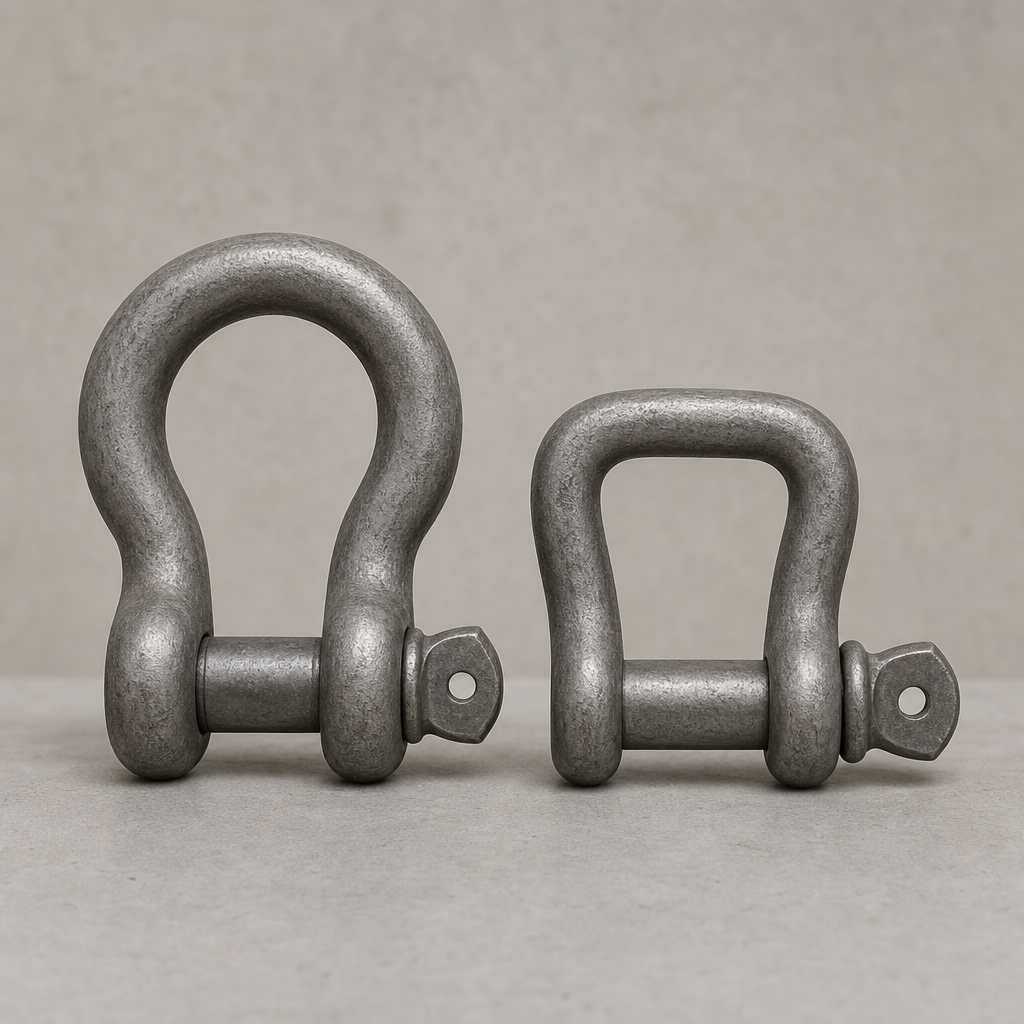
A shackle is a U-shaped forged body closed with a removable pin, used to connect slings, chains or rigging hardware to a load or to each other. The bow shackle has a rounded, wider body giving more room for multiple sling legs or an angled pull without the legs binding against the pin or body. The Dee (D) shackle has a narrower, near-parallel body and is generally used for straight, single-leg, in-line pulls where it is more space-efficient and, size for size, often rated somewhat higher in that specific direction.
Pins come in a few common types: a screw pin (threaded, tightened by hand or spanner, no split pin), a round/bolt-type pin (through-bolt with nut and cotter/split pin, resists rotation and vibration better), and a safety pin. Screw-pin shackles are for applications where the pin can be checked or is not exposed to vibration; bolt-type shackles are preferred for permanent, long-term or vibrating applications.
Identification: forged shackles carry the manufacturer’s mark, size, and working load limit stamped on the body, plus a grade marking. Unmarked or painted-over shackles with no legible identification should be removed from service.
What makes one unsafe:
- Wrong pin fitted (mismatched pin from a different shackle), pin not fully seated, or a screw pin not tightened
- Side-loading a Dee shackle, or loading any shackle across the pin instead of in the bow
- Deformation of the body (bent, opened out), nicks, gouges, cracks, or corrosion/pitting
- Illegible or missing markings so the WLL cannot be confirmed
- Pin thread damage or a bent pin
Before use: confirm the shackle and pin match, the pin is fully engaged and secured (tightened, or cotter-pinned on bolt-type), the body is undamaged and legibly marked, and the loading direction and sling angle are within the shackle’s rated capacity as marked.
Standarder: EN 13889 (forged steel shackles for general lifting purposes, bow and Dee types)