
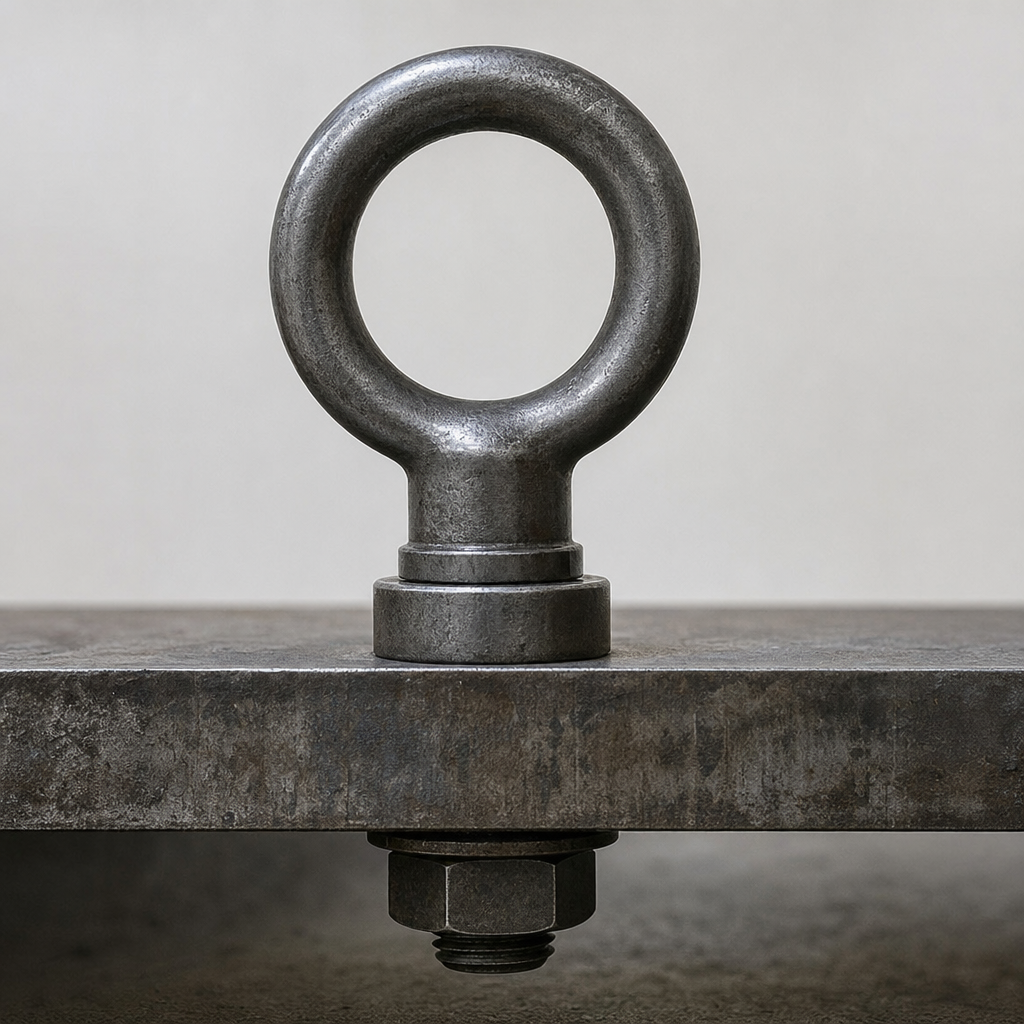
Every eyebolt is forged and rated for a defined direction of pull. A plain (uncollared) eyebolt is rated for in-line, vertical pull only — the shank has no feature to resist bending, so any angle away from the bolt axis puts the thread root and shank in bending and shear it was not designed for. A collared eyebolt can take some angular load because the collar seats against the load and shares the bending, but only up to the angle the manufacturer states, and its capacity still falls away steeply as the angle increases from vertical.
This matters constantly in practice: as soon as two or more eyebolts are used together in a multi-leg sling arrangement, the legs are almost never perfectly vertical, so every eyebolt in that arrangement is angularly loaded by definition. This is exactly why swivel lifting points exist, and why manufacturers publish angle-versus-capacity charts for collared eyebolts rather than a single flat rating.
What makes this unsafe in the field:
- Treating a plain eyebolt as if it were rated for angled pull because it “looks similar” to a collared one
- Reading capacity off memory or a generic rule of thumb instead of the manufacturer’s own angle chart for that specific product and size
- Not checking whether the sling leg angle at the eyebolt changes during the lift as the load tilts
- Ignoring a visibly bent shank or elongated eye — both are signs of a bolt that has already been side-loaded beyond its capacity
Before use: identify whether the eyebolt is plain or collared, obtain the manufacturer’s rated capacity for the actual angle the sling leg will pull at (not just the vertical rating), and if the geometry of the load forces a large angle on a plain eyebolt, use a collared eyebolt, a swivel point, or re-rig with a spreader so the pull stays in line. Any reduction figure or percentage quoted for a specific angle must come from that product’s own documentation — capacity at angle is not a fixed number across manufacturers or bolt types.
Standarder: DIN 580 (metric lifting eye bolts) — angle-of-pull ratings are manufacturer-specific and given in the product's technical documentation, not fixed by the standard itself.