
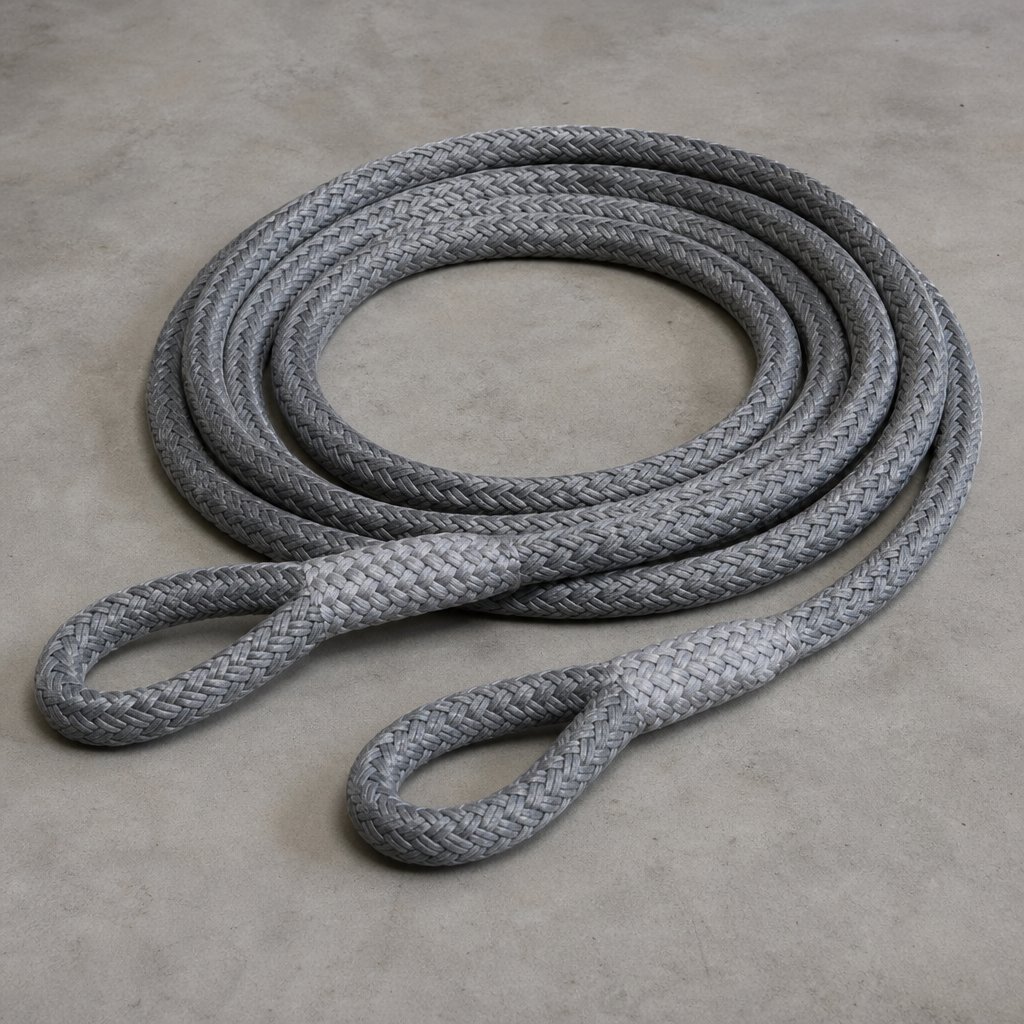
A fibre rope sling is formed from synthetic fibre rope — commonly polyester, nylon, or increasingly high-modulus polyethylene (HMPE, e.g. Dyneema/Spectra-type fibres) — with the ends spliced back into the rope body to form load-bearing eyes, rather than knotted. Splicing preserves far more of the rope’s strength than a knot does, which is why a knotted rope must never be treated as a rated lifting sling. These slings are used where a lightweight, non-marking, non-sparking sling is wanted, or where a very high strength-to-weight ratio matters, such as HMPE slings used for heavy lifts where a steel or chain equivalent would be impractically heavy.
Every sling must be tagged with its Working Load Limit for the relevant modes (straight pull, choked, basket) and angle, along with fibre type, and traceability information. As with any sling, the WLL on the tag is a starting point — actual safe load depends on the rigging configuration and angle of the legs.
Before use, check for:
- Cuts, abrasion, or fraying of the outer fibres, especially at the eyes and splices
- Melted, glazed, or fused fibres — a sign of heat or friction damage that can drastically reduce strength without being obvious at a glance
- Discoloration, stiffness, or a powdery residue, which can indicate chemical attack or UV degradation
- Pulled or slipping splices, or a change in rope diameter at the splice indicating the tuck has started to draw out
- Missing, illegible, or unreadable tags — a sling with no identifiable WLL should not be used
- Mildew or rot smell on natural-adjacent constructions, or embedded grit that abrades internal fibres invisibly
Fibre slings are vulnerable to damage mechanisms steel rope isn’t — UV, chemicals, heat, and internal abrasion from grit — so storage away from sunlight and contaminants, and periodic thorough inspection by a competent person, are as important as the pre-use check.
Standarder: ISO 9554 (fibre ropes — general specifications); ISO 2307 (fibre ropes — determination of certain physical and mechanical properties); ISO 18264 (textile slings — lifting slings from fibre ropes — HMPE) for HMPE constructions specifically