
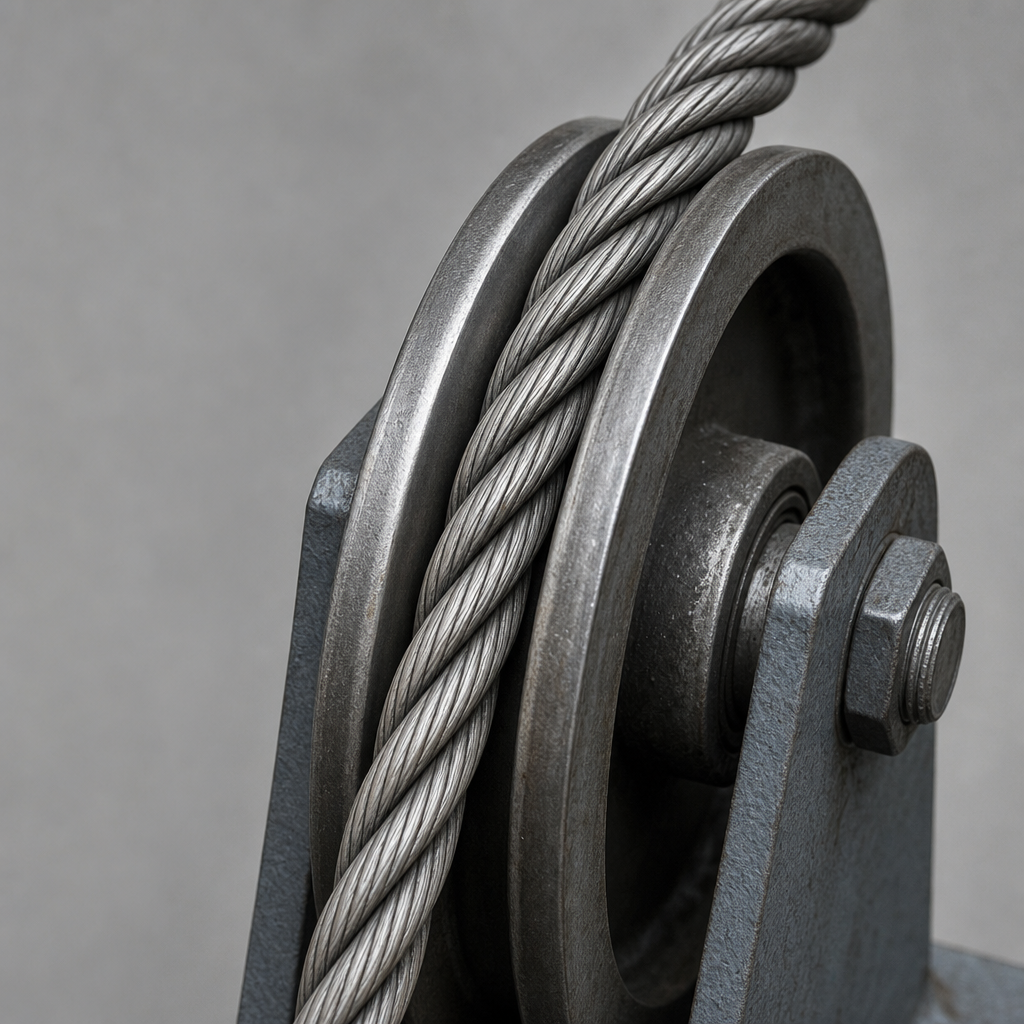
The running (or reeving) rope is the wire rope permanently installed on a crane’s hoist mechanism, running over sheaves and wound onto a drum. Unlike a sling, it is not swapped between lifts — it is inspected, maintained, and eventually replaced as part of the crane itself. Construction types vary (e.g. 6-strand or 8-strand, fibre-core or steel-core, ordinary or Lang’s lay) and the correct type for a given crane is specified by the crane manufacturer; substituting an unapproved construction can change bending fatigue life and drum/sheave compatibility.
Deterioration on a running rope is not uniform — the crossover points on a multi-layer drum wrap experience far more wear and crushing than a straight single-layer run, and inspectors must pay particular attention to those zones. The main deterioration types to look for are broken wires (external and, where checked, internal), wear (reduction in rope diameter), corrosion (surface or internal), and deformation such as kinking, birdcaging, core protrusion, waviness, or local flattening at a crossover or sheave contact point.
Before and during use:
- Confirm the rope is the type and diameter specified for that crane and drum/sheave arrangement
- Check for broken wires concentrated in one section or one strand rather than evenly scattered
- Look for diameter reduction, flattening, or crushing, particularly at drum crossover points
- Check for corrosion — surface rust is a warning sign; rust that has penetrated between strands is more serious
- Check end terminations (drum anchorage, socket, or ferrule) for security and deformation
Formal discard is governed by a documented inspection regime carried out by a competent person, using criteria that depend on the rope’s construction (Rope Category Number), the crane’s duty classification, and whether the rope runs on a single or multi-layer drum. An operator’s daily visual check is a first line of defence, not a substitute for that periodic formal inspection.
Standarder: ISO 4309 (cranes — wire ropes — care and maintenance, inspection and discard); EN 12385 series (steel wire ropes — safety)