
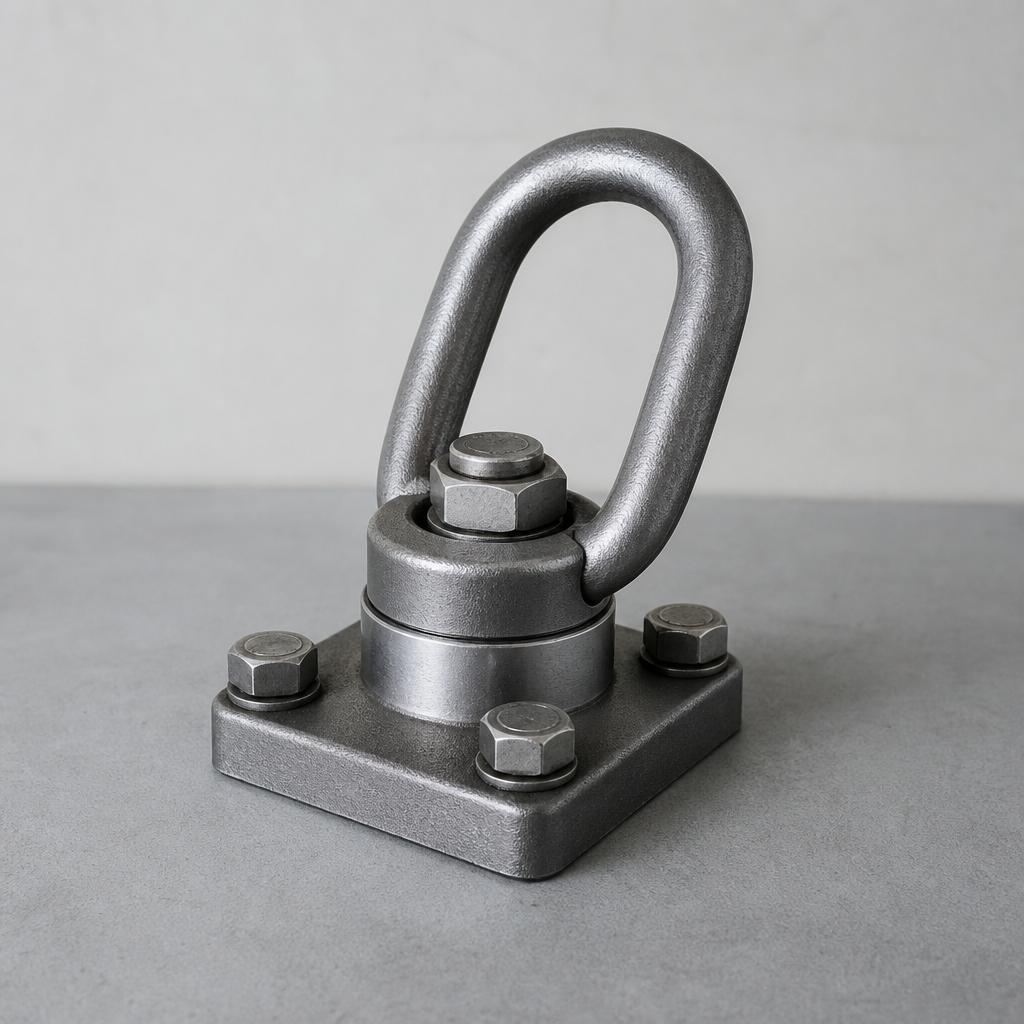
A swivel lifting point (also sold as a swivel hoist ring) is a forged fitting that screws into a tapped hole like a standard eyebolt, but the bail or eye is mounted on a bearing or bushing so it can both swivel around the bolt axis and often pivot in the plane of pull. This lets the attachment self-align with the sling leg as the load is lifted, tilted or rotated, instead of the eyebolt shank taking a fixed side load.
They are widely used where the load must be turned or tilted during the lift, on machinery with multiple lifting points at different angles, and generally anywhere a fixed eyebolt would otherwise be side-loaded. They are not a universal replacement for a plain eyebolt — the swivel and pivot mechanism itself has a rated capacity that depends on the direction and angle of pull, and that rating is set by the manufacturer, not assumed.
Identification: swivel points are marked by the manufacturer with size, working load limit and often a load-angle diagram showing how the rating changes with pivot angle. The bail should move freely by hand when unloaded.
What makes one unsafe:
- The swivel or pivot mechanism is stiff, seized, or does not rotate freely — this often means it has been overloaded, corroded, or contaminated
- Visible wear, elongation or play in the pivot pin or bearing
- Not fully seated against the load surface, same as a plain eyebolt
- Used beyond its rated angle range or with the wrong bolt grade for the tapped hole
- Missing or illegible markings, so the working load limit cannot be confirmed
Before use: screw down fully and torque as specified, cycle the bail through its range of motion by hand to confirm free movement, check the load angle against the manufacturer’s rating chart, and inspect the bearing area and eye for wear or damage. As with all eyebolts, the working load limit and permitted angles are read from the marking or manufacturer’s documentation, never assumed.
Standarder: Manufacturer-specific design standards; no single harmonised EN number covers swivel hoist rings as a class — check the individual product's declaration of conformity.