
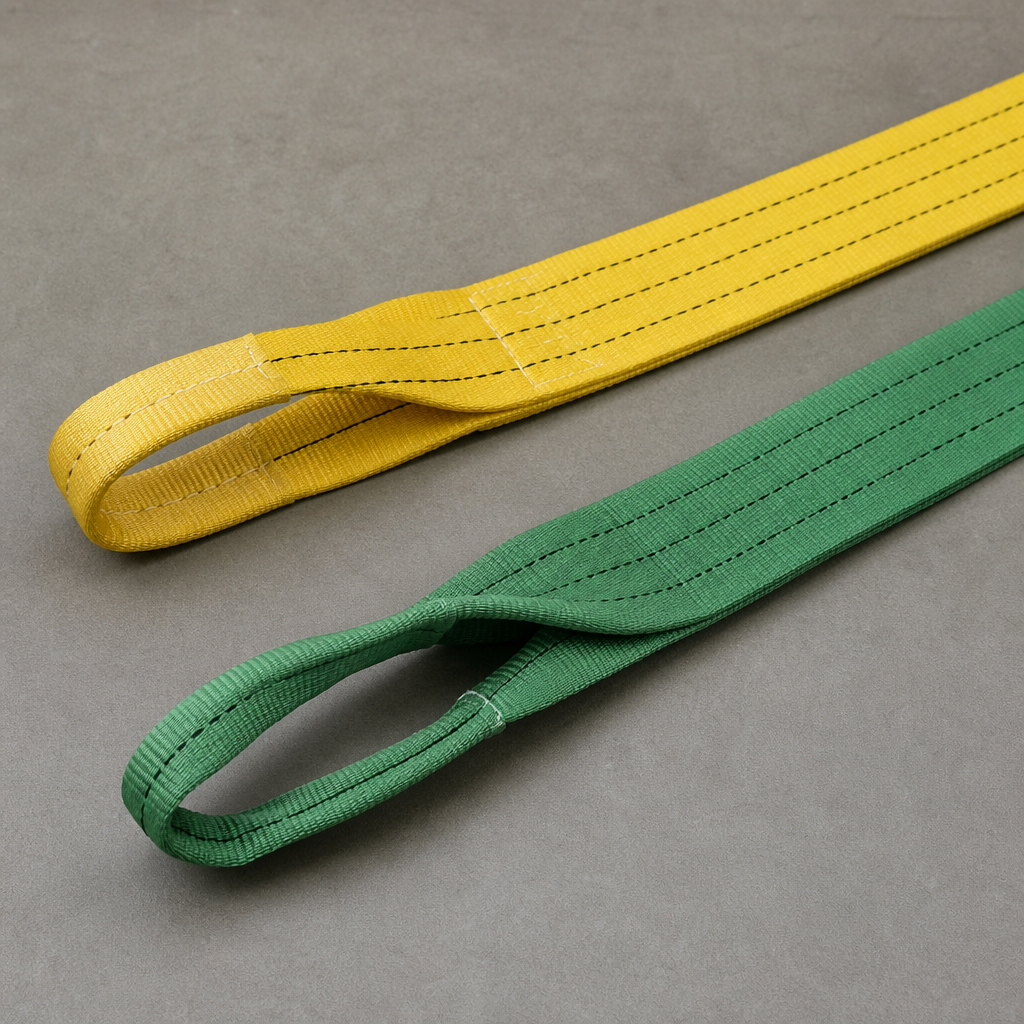
Flat webbing slings come with several standard eye or end configurations. The soft eye (flat, non-twisted loop) is the most common, formed by folding the webbing back on itself and stitching it into a loop; it is used for straight vertical lifts and for connection to shackles, hooks or lifting points where the eye can lie flat against the fitting. A twisted or reverse eye rotates the eye through 90 degrees relative to the body of the sling, which keeps the eye flat against a hook or crane fitting while the body of the sling lies flat against the load — this reduces wear from the eye rubbing or bunching against a fitting. Endless (grommet-style) webbing slings are produced as a continuous loop with no stitched eyes at all, giving four load-bearing surfaces and greater flexibility in hitch configuration, but are less common as a woven-webbing product than as a round sling construction.
What to check before use, specific to eyes and fittings:
- The eye should sit fully and squarely in the hook, shackle bow, or lifting point — never forced onto a fitting too small or too large for it, which concentrates load on the fold of the webbing
- Hooks and shackle pins in contact with the eye should be free of sharp edges, burrs or corrosion that could cut into the fibres
- Reinforcement or protective sleeving at the eye should be intact, since eyes see concentrated wear at the point of contact with fittings
- The sling should never be shortened or lengthened by knotting — a knot in webbing drastically reduces its strength and is not a permitted way of adjusting sling length
- Where two slings are connected via a single shackle or master link, check that the fitting is rated for the combined load and that both eyes seat correctly without crowding
Only use eyes and fittings in the configuration intended by the manufacturer and stated on the sling’s label. Mismatched or improvised connections are a common and avoidable cause of sling failure. Selection of eye type, hitch and fitting should be confirmed against the sling’s own documentation, and periodic inspection should specifically include the eyes as a wear point.
Standarder: EN 1492-1 (Textile slings — Flat woven webbing slings made of man-made fibres for general purpose use)