
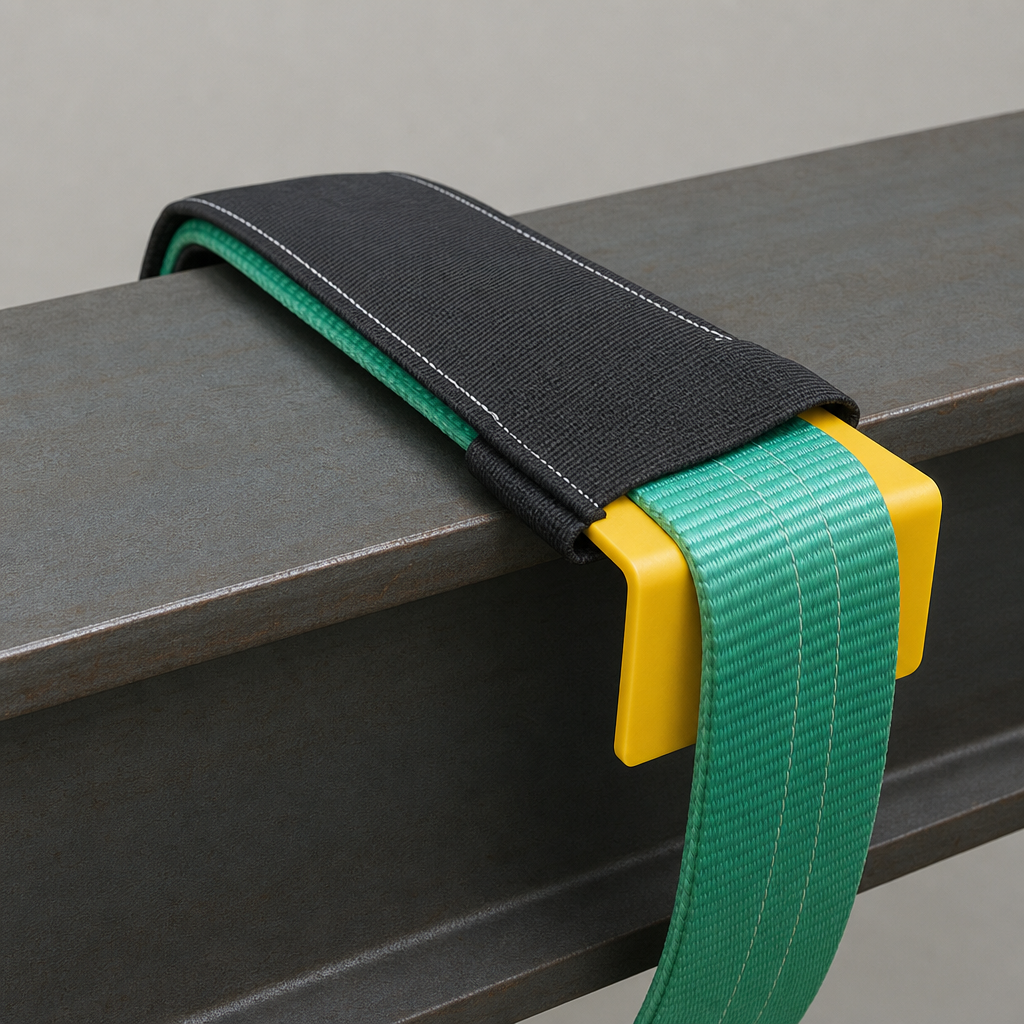
Flat webbing slings are strong in tension along the length of the fibres but are vulnerable to cutting, abrasion and localised damage where they bear against a sharp edge, rough surface or corner of a load. Unlike a small nick from general wear, edge damage can progress to failure very quickly since load concentrates on the point of contact rather than being spread across the width of the webbing.
Common forms of edge and surface protection include separate corner protectors (plastic, rubber, or hardened material placed at the point of contact), sewn-on wear pads on the sling itself, and full protective sleeving along sections of the sling that will contact a load repeatedly. Protection should be selected for the specific hazard: a hard, sharp steel edge needs different protection than a rough, abrasive concrete or stone surface.
What to check before and during use:
- Identify any point where the sling will pass over a corner, edge, protrusion or rough surface before rigging the lift, not after
- Fit edge protection at every such point — do not rely on the webbing alone to survive contact with a sharp corner
- Inspect any sewn-on protective sleeve or pad for wear-through, since its job is to sacrifice itself before the load-bearing webbing is damaged
- Check that edge protectors themselves are not cracked, crushed or displaced during the lift as the load shifts
- Look for shiny, glazed or thinned patches on the webbing from previous lifts, which indicate abrasion has already occurred and may not be visible as an obvious cut
Any sling showing cuts, thinning, or fibre damage consistent with edge contact should be withdrawn from service. Planning edge protection into the lift — not improvising it — is a basic part of safe rigging practice and is expected of a competent rigger under Norwegian requirements for planned, documented lifting operations.
Standarder: EN 1492-1 (Textile slings — Flat woven webbing slings made of man-made fibres for general purpose use)