
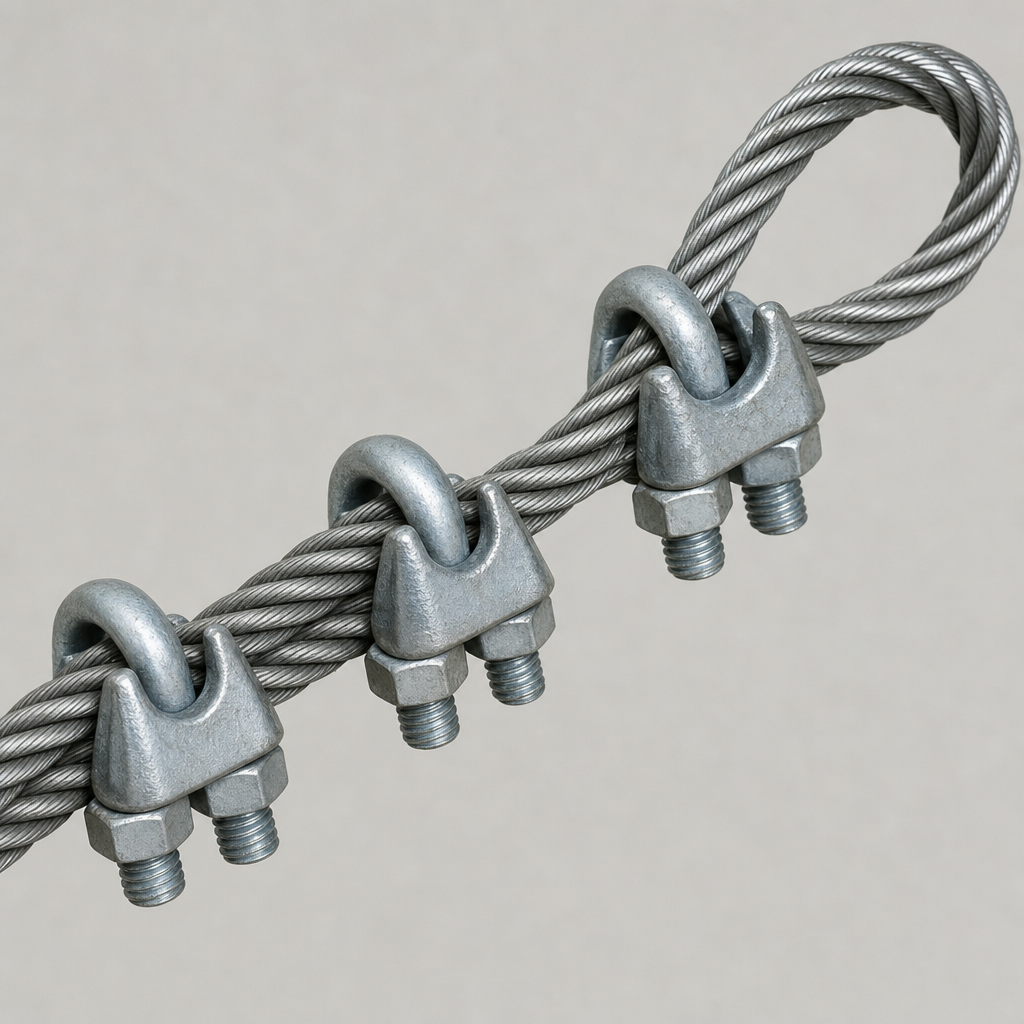
A wire rope grip — also called a U-bolt clip, bulldog grip, or wire rope clamp — consists of a U-bolt, a grooved saddle, and two nuts. Several grips fitted along an overlap of rope form a mechanical termination without splicing or swaging. They are cheap, quick to fit, and commonly seen securing guy wires, fall-arrest anchor lines, temporary stays, and non-critical restraints — but they are a poor substitute for a proper swaged or spliced eye on a lifting sling.
Correct fitting matters more than most riggers assume: the saddle (the smooth part) always sits on the load-bearing (live) side of the rope, and the U-bolt goes over the dead/tail end — never saddle a dead horse. Grips must be spaced according to the manufacturer’s table (typically several rope diameters apart), fitted in the specified quantity for the rope diameter, and torqued to the specified value. Nuts loosen under cyclic load, so retensioning after initial load and periodic re-checks are standard practice, not optional.
What makes a grip assembly unsafe:
- Grip fitted backwards (saddle on the dead end) — this crushes and weakens the live rope
- Wrong number of grips, or spacing not matching the manufacturer’s chart
- Under- or over-torqued nuts, or nuts that have visibly worked loose
- Deformed, cracked, or corroded U-bolts or saddles
- Any sign the rope has been crushed, birdcaged, or has broken wires at the clamp
Manufacturers explicitly state these grips are not intended as the primary termination for crane hoist ropes or for sling eyes on general lifting slings — those applications require a spliced or swaged termination assessed to the relevant sling standard. Where a grip termination is used at all in a lifting context, it should only be on the basis of a documented risk assessment by a competent person.
Standarder: EN 13411-5 (terminations for steel wire ropes — safety — U-bolt wire rope grips)