
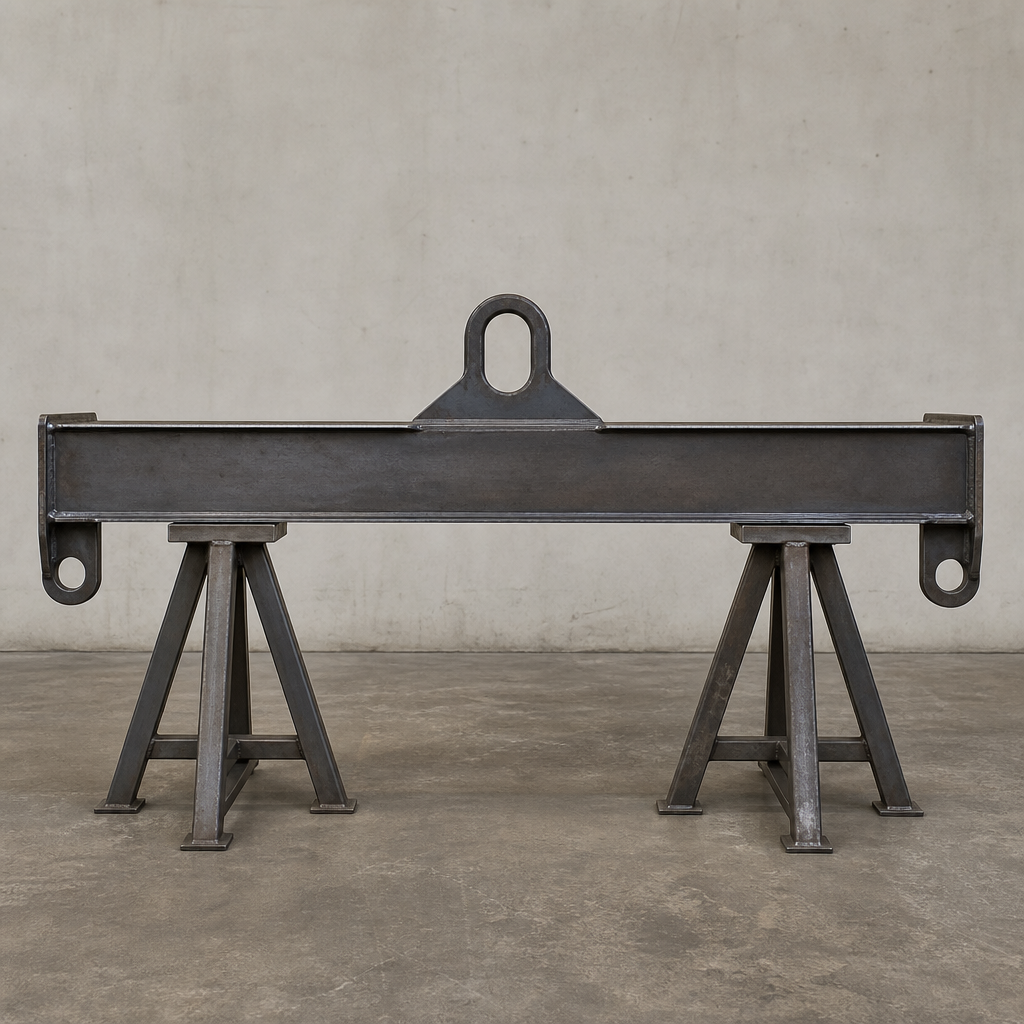
Both lifting beams and spreader beams (Norwegian: løfteåk) are rigid load-carrying attachments used between the crane hook and the load, typically to control sling angle, protect a load from sling-induced compression damage, or spread lifting points across a long or fragile object. They are not interchangeable, and misidentifying one for the other is a common and serious rigging error.
A lifting beam hangs from a single central attachment point at the crane hook. The load slings attach to points below the beam, and the beam itself is loaded in bending — it must resist sagging along its length, similar to a simply supported beam under distributed load. Lifting beams are typically used when the load has two lifting points a fixed distance apart, or when a spreader arrangement is not otherwise needed.
A spreader beam, by contrast, is suspended from two separate top slings (one at each end) running up to the crane hook, forming an inverted-V geometry above the beam. The beam itself sits in compression between the two support slings, while the load slings hang below it, usually vertically, which keeps sling angles favourable and avoids the load-crushing effect of a wide sling angle over a delicate load.
Both types must be marked with their working load limit, and — critically — the WLL for a beam that can be rigged at more than one span or attachment configuration must be given for each valid configuration, since capacity typically changes with the geometry used. Before use, check the identification plate for the correct WLL and configuration, check for cracks, bent flanges, or bowing in the main beam, check that all pins, shackles and lifting points are correctly rated and free of wear or deformation, and confirm the beam’s attachment points match how the load is actually rigged. Never use a beam rated for one configuration in another without checking the plate.
Standarder: EN 13155 (cranes — safety — non-fixed load lifting attachments)